Tampilkan postingan dengan label NSA. Tampilkan semua postingan

Oduah: Jonathan, NSA in closed-door meeting

Posted by Unknown Rabu, 06 November 2013 0 komentar
The National Security Adviser, Col. Sambo Dasuki (retd.), on Wednesday  met behind closed-doors with President Goodluck Jonathan at the Presidential Villa, Abuja.
Dasuki is a member of the three-man administrative panel set up by Jonathan to probe the Minister of Aviation, Ms Stella Oduah, over the N255m bulletproof cars purchased for her by the Nigerian Civil Aviation Authority.


The panel, which is led by a former Head of Service of the Federation, Alhaji Isa Bello, also has Air Vice Marshal Dick Iruenebere (retd.) as members.
Dasuki came out of the President’s office at about 5.40pm and was driven out of the Villa.
It was not clear whether issues bordering on the probe formed part of the agenda of his meeting with the President.
His office is said to be saddled with the responsibility of approving amoured vehicles before they can be imported into the country.
The NSA refused to speak to journalists who approached him for comment on the works of the committee.
Jonathan had set up the committee at the peak of public outcry that trailed the purchase of the bulletproof cars.
In announcing the establishment of the committee, Special Adviser to the President on Media and Publicity, Dr. Reuben Abati, had said members were expected to, among other things, ascertain whether the procurement of the vehicles followed due process, ascertain the purpose of procurement and inquire into any other incidental matter. The President also met with some governors in the Jonah Jang-led faction of the Nigeria Governors Forum on Wednesday.
Vice President Namadi Sambo and the Chief of Staff to the President, Chief Mike Oghiadomhe, also attended the meeting.
The governors in attendance were Vice Chairman of Jang’s faction, Governor Olusegun Mimiko of Ondo; Chairman of the Peoples Democratic Party Governors Forum, Governor Godswill Akpabio of Akwa Ibom State; Governor Emmanuel Uduaghan of Delta State; and Governor Seriake Dickson of  Bayelsa State.
Dickson, who left the Presidential Villa earlier than others did not speak to journalists. Uduaghan and Mimiko, who arrived at the same time, also left together at about 7.25pm. Mimiko told journalists that the meeting was an informal parley with the President on issues bordering each state.
“It’s an informal meeting. From time to time, issues come up that we have to discuss with him (the President). They are issues bordering on governance,” he said.
Akpabio who left last exited the President’s office at about 8.45pm.
He did not talk to journalists.

Baca Selengkapnya ....

United States of Espionage: Timeline of NSA's blatant spy programs - Full Update !!!

Posted by Unknown Rabu, 30 Oktober 2013 0 komentar

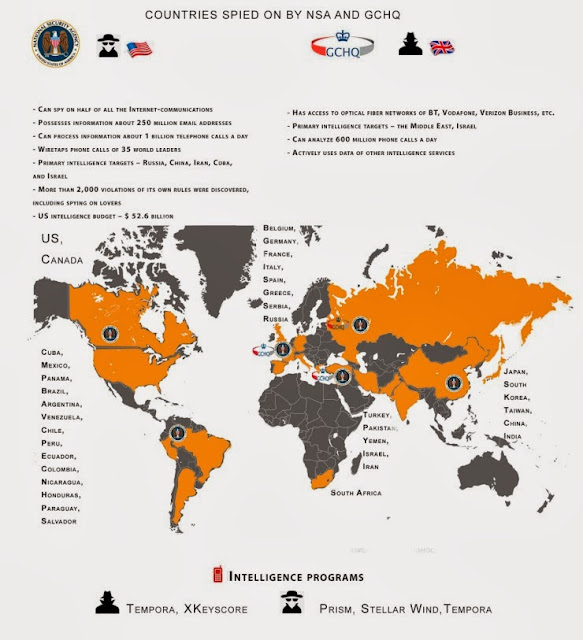
Former NSA contractor Edward Snowden revealed that the US National Security Agency (NSA) spied on its world's foes and allies, including Russia, China, Iran, Cuba, Israel, several Latin American countries and Europe: Germany, Italy, Spain and others. Here is Part One of the timeline of the NSA's blatant spy programs from June to September 2013. (INFOGRAPHIC MAP)
Continue

6 June – Media reveal that the US National Security Agency (NSA) has been spying on communications of Verizon customers in the US as part of the Prism surveillance program. The leak blows the lid off the NSA scooping up data directly from the servers of major US Internet providers.
7 June – The Guardian newspaper publishes a memo that lists potential targets for US surveillance and outlines its methods.
It is further revealed that the Government Communications Headquarters (GCHQ) in the UK helped itself to the data from NSA’s communications tapping program.
9 June – Michael Hayden, who headed the NSA under George W. Bush, says Obama’s presidency saw a hike in US surveillance.
11 June – The Guardian discloses NSA's tool for cataloguing global data that shows the agency has received a total of 30 billion data reports on web traffic over thirty days, with over 97 billion reports collected globally over March 2013.
14 June – The South China Morning Post says the NSA hacked Hong Kong and China servers.
16 June – The Guardian reports that US and UK intelligence spied on foreign diplomats at the G20 summit in 2009. One of them being Russia’s Dmitry Medvedev. The NSA is revealed to have bugged South Africa’s foreign office and planned to spy on delegates at the Commonwealth Heads of Government Meeting in 2009.
British Ambassador David Reddaway is summoned to the Turkish Foreign Ministry to officially comment on the Guardian’s claims about its tapping of the Turkish delegation led by Finance Minister Mehmet Simsek at the G20 summit in 2009.
19 June – The New York times accuses Skype of creating a program in 2008 that gave intelligence access to its customers’ message exchange. As of 2011, over 633 million users were registered with Skype.
21 June – The Guardian shed some light on spying programs, such as Prism-like Tempura, run by the British-based GCHQ. The Government Communications Headquarters collected phone data of an estimated 600 million people daily. The tempura program let the GCHQ access communications of two billion Internet users.
27 June – It emerges that the Obama administration kept running the Internet-traffic assessing Stellar Wind program well past George Bush’s presidency.
The Guardian reports that by December 2012 a special NSA unit had scooped up data on the Internet traffic of over a trillion users.
20 June – The Guardian says the NSA spied on 38 foreign embassies and diplomatic missions. The list of tapped embassies includes those of Middle East countries, as well as France, Italy, Greece and several US allies such as Japan, Mexico, South Korea, India, and Turkey.
Germany’s Der Spiegel claims US intelligence was tapping a total of 20 million phone calls and 10 million internet connections in Germany every single day.
28 June – UK journalist Glenn Greenwald claims he possesses documents that prove the US can process a billion of phone calls a day.
2 July – Turkish foreign office summons a high-ranking US official to question him about the alleged US-run intelligence program that was said to have bugged diplomatic missions.
4 July – Le Mond reveals that French intelligence was monitoring the majority of phone calls and Internet traffic in the country for two years.
6 July – Brazil’s O Globo newspaper publishes an article by Glenn Greenwald that deals with NSA’s Fairview, a secret mass surveillance program that collected phone and traffic data across Brazil.
9 July –Greenwald’s second article in O Globo reveals that the US spied on citizens of most Latin American countries, including Mexico, Venezuela, Columbia, Ecuador, Argentina, Panama, Costa Rica, Nicaragua, Honduras, Paraguay, Chile, Peru, and Salvador.
10 July – The Washington Post releases information on PRISM's brother called Upstream, which collects from the fiber-optic cable networks.
20 July – Der Spiegel claims German intelligence was cooperating with US spies, lobbying hard against tougher data protection rules to have more leeway for surveillance.
31 July – The Guardian publishes a presentation on NSA’s surveillance program Xkeyscore that has 500 servers around the world and can track virtually every step made on the Internet. The paper says it collected data on 1-2 billion connections daily.
1 August – The NSA is revealed to have paid GCHQ a total of $155 million from 2010-2013, since UK laws allowed for wider surveillance.
2 August – Brazil’s Epoca publishes information that implicates US diplomats in using intelligence data to gain an edge on UN partners at the Iran nuclear talks and the Summit of Americas in 2009.
Die Sueddeutsche Zeitung reveals that seven communication giants, including BT, Vodafone, and Verizon Business, let the GCHQ access their fiber-optic cables networks and analyze some 600 million phone calls a day.
9 August – Journalists find out that NSA guidelines allow it to log onto US servers without a warrant. Senator Ron Wyden admits the NSA could not tell the number of Americans they have been spying on.
15 August – The Washington Post reports 2776 incidents of the NSA violating its own surveillance rules from March 2011 until March 2012. It says NSA employees used the agency’s enormous eavesdropping power to spy on their love interests.
21 August – The NSA declassifies three secret court rulings that prove the agency collected an average of 56,000 emails a year that were sent by American nationals not suspected of terrorist activities.
Ecuador's President Rafael Correa claims several Latin American countries have been spied on, although he doesn’t name whose intelligence stood behind this mass surveillance. The president says the unnamed spies intercepted emails and phone calls and stresses he has enough evidence that government communications have also been tapped.
26 August – The Independent announces that Britain runs a secret Internet-monitoring station in the Middle East to intercept data from fiber-optic cables passing through the region. However Glenn Greenwald later denies this information may have stemmed from former NSA contractor Edward Snowden.
29 August – The Washington Post says US intelligence paid tens of millions of dollars to communications companies for clandestine access to their fiber-optic cables networks.
The US secret surveillance budget is estimated at $52.6 billion. Primary targets are revealed to be Russia, China, Iran, Cuba and Israel.
30 August – US intelligence is accused of carrying out 231 cyber-attacks over 2011, every third of them targeting servers in Russia, China, Iran and North Korea.
August 31 - Der Spiegel reports that NSA hacked into the secure internal communications systems of the Aljazeera TV network.

United States of Espionage: timeline of NSA's blatant spy programs. Part 2
After former NSA contractor Edward Snowden revealed that the US National Security Agency (NSA) spied on its world's foes and allies, major world powers started to summon US ambassadors and demanded explanations. Here is Part Two of the timeline of the NSA's blatant spy programs from September to October 2013.
September 1 -The Washington Post reports that the NSA has been spying on Pakistan, a US ally, more than on any other country.
Journalist Glenn Greenwald reveals that the NSA wiretapped the phone calls of Mexican President Enrique Pena Nieto and Brazilian President Dilma Rousseff. The Brazilian leader cancels her official visit to the United States.
September 5 - It’s been reported that the NSA cracked the private data encryption codes of millions of web users.
September 7 - Der Spiegel reports that the NSA accessed smartphone data from all leading makers. Both mass smartphone surveillance and spying on individual smartphones was practiced.
September 9 - Brazil’s Fantastico reports that the NSA infiltrated the computer networks of the Brazilian oil company Petrobras, the French Foreign Ministry and the SWIFT banking system, disproving allegations of the NSA’s non-involvement in corporate espionage.
September 11 - The US and Israeli secret services publish a memorandum on NSA data sharing with Israel. The NASA refuses to disclose how many Americans the Israeli intelligence agencies wanted to check.
September 16 - It emerges that the NSA has been monitoring VISA and Mastercard credit card transactions. Britain’s GCHQ says that plenty of "irrelevant" private data was collected along the way.
September 17 - NSA spy scandal breaks out in Belgium. Der Spiegel reports attempts by Britain’s GCHQ to infiltrate the Belgian telecommunication company Belgacom. Not only the NSA but also Israel’s secret services have possibly been involved in cyber espionage against Belgacom. Ten years ago, the company acquired an Israeli-based technology that enabled foreign secret agencies to intercept its client data.
September 23 - The Hindu newspaper accuses the US secret services of accessing data on India’s nuclear and space programs and domestic policy. India’s embassy and UN mission in the United States have both been under surveillance.
September 25 -Investigative reporter Glenn Greenwald comes up with revelations showing that opponents of the use of drones in the war on terrorism are referred to in NSA documents as a "threat."
September 28 - The New York Times reports that the NSA uses people’s private data to create detailed graphs of their social connections.
September 30 - The Guardian reports that the NSA stores the online metadata of millions of Internet users for up to a year, regardless of whether they are connected to a terrorist target. The newspaper cites expert Jeff Jarvis as saying that the NSA monitors about half of all communications on the Web.
October 4 -The NSA and the GCHQ are accused of attempting to compromise the TOR computer networks that users to protect their data.
October 7 -The Fantastico reports that Canada’s secret services spied on Brazil’s Energy and Natural Resources Ministry in favor of Canadian companies.
October 14 -The Washington Post reports that the NSA has been sifting through 250 million e-mail lists.
October 16 - It’s been reported that the CIA uses NSA data to prepare operations involving unmanned aircraft.
October 20 - Der Spiegel unveils information showing that the NSA was spying on Mexico’s former President Felipe Calderon and Cabinet ministers.
October 21 - Le Monde reports massive spying on French citizens, diplomats and companies by the NSA. The agency intercepted some 70.3 million items of French telephone data and was spying on French diplomats in the United States.
October 23 - Le Monde’s revelations and a scandal around German Chancellor Angela Merkel’s phone being tapped by the NSA spark calls for a review of the cooperation agreement between the US and European intelligence agencies.
October 24 - The Guardian reports that the NSA was eavesdropping on the phone calls of 35 world leaders.
L’Espresso reports that the NSA and GCHQ have spied on the Italian government, Italian companies and millions of Italians.
October 26 - Allegations emerge that Angela Merkel has been wiretapped by the NSA since 2002 and that a special intelligence center was created at the US embassy in Berlin. The White House denies that a wiretap of Merkel had President Barack Obama’s personal approval.
October 28 - It’s been reported that the NSA intercepted 60.5 million phone calls, texts and e-mails in Spain between December 19, 2012 and January 8 this year. Spanish politicians and Cabinet members were among those whose phones were tapped.


Details
US President Barack Obama has known since as long as 2010 that the NSA tapped German Chancellor Angela Merkel’s phone.
- In 2010, NSA Director Keith Alexander personally informed Obama about a secret operation targeting Merkel. A well-informed US intelligence source told the Bild am Sonntag newspaper on condition of anonymity that Obama "not only did not stop the operation, but he also ordered it to continue."
- The NSA read Merkel’s sms messages and eavesdropped on her phone calls. Only the stationary phone in her bureau in the Federal Chancellery was inaccessible, according to the Bild am Sonntag.
- Obama apologized and assured Merkel that he had been unaware of the phone bugging or he would have ordered to cease it.
- In 2002, the NSA put Merkel, back then an opposition leader, on its European Target List. Later, she was assigned the code-name "GE Chancellor Merkel". The Bild am Sonntag claims that a joint intelligence unit of NSA and CIA at the US embassy in Berlin monitored cellphone communications in the government quarter.
In a fresh phone bugging revelation, former Italian Prime Minister Romano Prodi said that ten years ago when he had been President of the European Commission, his phone had been tapped by US secret services. "My tone of voice and my speech peculiarities were inserted into some database, so all my phone calls were intercepted irrespective of the telephone I was using," Interfax quoted Prod as saying in an interview.
France regularly shares raw intelligence data with the United States Britain under a trilateral data sharing deal, the Süddeutsche Zeitung newspaper reports, citing information leaked by former CIA contractor Edward Snowden.
Also, France has an intelligence sharing treaty codenamed Lustre with five English-speaking countries, the so-called Five Eyes club that comprises the United States, Britain, Canada, Australia and New Zealand. They share electronic surveillance data but pledged not to spy on each other.

The United States used Britain’s Menwith Hill spy base in North Yorkshire to wiretap Merkel and other world leaders. Menwith Hill is an Air Force base and Europe’s largest electronic surveillance base with 33 antennas. The NSA used it to process the intercepted phone and e-mail data.
There were around 80 NSA-CIA intelligence units in the world in 2010, most of them dating from as far as the 1970s, including 19 in Europe – in Paris, Madrid, Rome, Prague and Geneva and also in Berlin and Frankfurt am Mein, Der Spiegel reports.

Baca Selengkapnya ....

Head of the US intelligence publishes classified materials about NSA - Full Update

Posted by Unknown Selasa, 29 Oktober 2013 0 komentar

Head of the US National Intelligence James Clapper has released several secret documents about the programs of surveillance of the National Security Agency (NSA), EFE reports Tuesday.

Continue after the break.
...
Most of the documents are dated back to 2009. There are also materials, which date back to 2011, the Agency says.
The documents state that the US Department of Justice authorized gathering of data about conversations on mobile phones, starting with 2010.
Other materials report that the NSA, FBI and the Ministry of Justice informed congressmen of their intention to increase the collection of metadata of phone calls, including phone numbers and time of calls, but not their contents.
By publishing these documents, James Clapper tries to convince US citizens that the NSA's programs of surveillance do not violate their right to privacy.
As it was reported, the materials published by former employee of the CIA Edward Snowden stated that the NSA had conducted surveillance over the governments of a number of European countries, including Germany, Spain and France, as well as over ordinary citizens.

US mass surveillance of European Union citizens is genuine concern - European MP
British Member of European Parliament of Labour Party, Claude Moraes, a member of the delegation, told reporters that "this mass surveillance of European Union citizens is genuine concern." He also said he and his fellow delegates were unsatisfied with the responses from US officials on the issue.
"They’re giving us answers, but not the answers we want," Mr. Moraes said.
Spain, which is, reportedly, one of the latest targets of the NSA snooping activities, has urged the United States to give details of any eavesdropping. One the latest allegations published by El Mundo newspaper is that the NSA tracked 60 million Spanish telephone calls in a month.

Spain’s Minister for European Affairs, Inigo Mendez de Vigo, described such practices as "inappropriate and unacceptable."
Additionally, the NSA has tracked more than 46 phone calls in Italy. That’s according to the US website Cryptome.

That prompted Italian Prime Minister Enrico Letta to question US Secretary of State John Kerry about the alleged snooping.  Despite all that, Italian intelligence agency failed to confirm the information.
Cryptome also revealed information that during the same month the NSA monitored 360 million phone calls in Germany, 70 million in France, and near two million in the Netherlands.

Meanwhile, Senator Diane Feinstein, who chairs the Senate Intelligence Committee, has been quoted as saying that she was "totally opposed" to the National Security Agency’s intelligence gathering on leaders of US allies. Senator Feinstein pledged that her committee will undertake a major review into all intelligence collection programs.

White House says US intelligence gathering may require 'additional constraints'
Washington has acknowledged the need for additional constraints on US intelligence gathering. Spokesman Jay Carney has said an ongoing White House intelligence policy review would take into consideration 'privacy concerns'.

President Barack Obama has full confidence in the director of the National Security Agency, General Keith Alexander, and other NSA officials, said White House spokesman Jay Carney. He added that there should be a balance between the need to gather intelligence and the need for privacy.

"We recognize there needs to be additional constraints on how we gather and use intelligence," Carney said.
A White House review of US surveillance capabilities is well under way and should be completed by the end of the year, Carney said.


US spying on allies is 'inappropriate and unacceptable' - Spain's minister
Outrage in Europe over US surveillance operations widened Monday after a report that the National Security Agency (NSA) tracked 60 million Spanish phone calls in one month.

The US spy agency intercepted the calls between December 10 and January 8 and mined data from internet searches, email and social networking sites such as Facebook and Twitter, El Mundo newspaper reported.
The documents have shown the US engaging in large-scale surveillance of foreign governments and citizens, from rivals such as China and Russia to allies in Europe and South America.
Spain's minister for European affairs, Inigo Mendez de Vigo, questioned the US ambassador to Spain, James Costos, for some 40 minutes Monday over the latest snooping claim, the government said.
Such spying among friends was "inappropriate and unacceptable," Mendez de Vigo said.
The US embassy in Madrid said after the meeting that the surveillance programmes have aided the security interests of both countries.
The uproar to Italy, where the Wikileaks-style website Cryptome claimed the NSA spied on 46 million calls in that country in a one-month period in December and January.
The embarrassing disclosures come on the heels of a report last week that the NSA had tapped German Chancellor Angela Merkel's mobile phone. The German Foreign Ministry summoned the US ambassador for the first time since World War II.
In a Wall Street Journal story, NSA officials for the first time admitted clandestine monitoring of some 35 world leaders. President Barack Obama was unaware of the spying, and the White House only halted the practice a few months ago after an internal review, the newspaper reported.
White House spokesman Jay Carney would not comment on the report that Obama had been unaware until recently of long-running monitoring of world leaders. The White House was conducting a review of US intelligence operations, and Obama believed the US should "not just be collecting data because we can, but because we should," Carney said.
He defended the broader surveillance measures as necessary in a more technologically interconnected world.
"If we're going to keep our citizens and our allies safe, we have to continue to stay ahead of these changes, and that's what our intelligence community has been doing extraordinarily well," Carney said, while acknowledging the need for a review of US surveillance efforts.
The review ordered by Obama is to be completed by the end of the year. The Guardian journalist Glenn Greenwald, who has reported many of Snowden's leaks, rejected White House suggestions that the sprawling data collection was needed to combat terrorism.
"None of this has anything to do with terrorism," he told broadcaster CNN. "Is Angela Merkel a terrorist?"
Pressure was growing on the administration within Congress, as Dianne Feinstein, chairwoman of the Senate Intelligence Committee, sharply criticized the NSA, which she has defended in the past, and call for an investigation into the spying of foreign leaders.

Visiting EU parliamentarians were in Washington for meetings including White House national security staff, top intelligence officials, the State Department and others.  German government spokesman Steffen Seibert said the government had "no new information" on allegations of wiretapping by American intelligence services.
"We are in the process of clearing up this serious case," he said, adding that "Germany and the US can solve these problems together."
Berlin said its intelligence chiefs and representatives of the chancellor's office would be sent to Washington to demand answers. The timing of the trip was still unknown, Seibert said, but it is expected to include a meeting with NSA representatives.
He declined to say what questions had not been answered by US authorities following a similar Washington visit in June, after initial revelations of US spying activities on citizens in Germany and Europe.
Germany and Brazil are set to introduce a non-binding UN General Assembly resolution Tuesday against spying on electronic communication, a UN diplomat said.
Brazilian media reported in September that the NSA had monitored President Dilma Rousseff's phone and email communications with her advisers, prompting her to call off a state visit to Washington.
At a summit last week dominated by the deepening row, the European Union appointed Merkel and French President François Hollande to lead an effort to bring the United States to account in the scandal and restore trust within the Atlantic alliance.

NSA collected data on 60 mln phone calls in Spain in one month
The US National Security Agency intercepted and collected data on 60 million phone calls in Spain from December 2012 to January this year without prior consent of the Spanish authorities. The El Pais newspaper reports today that the information to that end has been presented by a British journalist Glenn Greenwald, who is publishing revelations by the former US special service agent Edward Snowden.
El Pais adds that the National Security Agency was not interested in the content of the conversations, it only determined the duration of the conversations, identified the phone numbers and established the whereabouts of subscribers.
The newspaper also reports that the US Ambassador to Spain has been summoned to the Foreign Ministry of the Kingdom in compliance with an order from Prime Minister Mariano Rajoy. The move has been prompted by local press reports about US special service spying on millions of rank-and-file Spaniards, as well as politicians and government members of the kingdom.

More that 46 million phone calles tracked by NSA in Italy
New information is coming out on NSA surveillance. It has been revealed that the spy agency was tracking phone calls in Italy. More than 46 million calls were checked by the US according to the US website Cryptome. Previously, was learned that the NSA was tracking phone calls in Germany, including those of German Counselor Angela Merkel. As it appears the agency listened to millions of users all across Europe.
Cryptome reported that in a month's time the phone data of the users has increased enormously and as well as the duration of calls.

Enrico Letta, Italian Prime Minister stated last week that this kind of behavior is "inconceivable and unacceptable." Later on, he questioned John Kerry, the US Secretary of State about the information revealed. What was bothering Letta is not the surveillance but hiding the truth from the Italian officials. "Obviously, all checks should be done, but we want the whole truth. It's not acceptable or conceivable that there are activities of this kind.”

Despite all that, Italian intelligence agency couldn’t confirm the information. In the statement they released it was stated that one should differentiate between 
“spying” and "monitoring.” In the same statement the government reports: “There is no evidence that the United States is spying on Italian citizens.”
At the same time, Cryptome also revealed information that during the same month the NSA monitored 361 million phone calls in Germany, 70 million in France, 61 million in Spain, and 1.8 million in the Netherlands.
No matter which way it is, these revelations are deepening the scandal between the US and its allies. Last week, it was reported that German Counselor is wishing to hold a meeting with European and the US representatives to receive an official statement on the US activity.

US halts its surveillance programs of allied heads of state - report
The US National Security Agency stopped tapping the phones of German Chancellor Angela Merkel and other world leaders once the White House learned of its activities. The media has shared more details on the federal government’s attitude towards massive surveillance.

The Wall Street Journal reports that the NSA program to bug the phones of its allies' leaders was scrapped as soon as the Obama administration got wind of it. However, it did not abort all surveillance programs as many of them brought intelligence benefits. The only fact that has been confirmed is the subsequent debugging of Merkel’s cell-phone.

The Wall Street Journal also claims that Barack Obama was kept in the dark about the NSA program targeting world leaders during his five-year presidency. According to the US paper, the NSA cannot inform the head of state about all of its numerous projects. Some of them are signed into force by the NSA chief and don’t need presidential approval.

Last summer, UK and US media blew the lid off the spy agency’s total surveillance programs that were exposed in the classified documents leaked by former NSA contractor Edward Snowden. The ensuing furore prompted the White House to open an internal investigation into the agency’s dealings that showed the NSA had monitored the phone calls of 35 foreign leaders.

NSA had tapped the phones of some 35 world leaders - report
The White House ended programs tracking several of the leaders including Merkel, according to the Journal.
Some programs have been scheduled to end but have not yet been terminated, the Journal said.
Officials told the Journal that there are so many NSA eavesdropping operations that it would not have been practical to brief the president on all of them.
Obama was "briefed on and approved of broader intelligence-collection 'priorities," but deputies decided on specific intelligence targets, the Journal said.
 "These decisions are made at NSA," the unnamed official told the Journal.
"The president doesn't sign off on this stuff." Ending a surveillance program is complicated because a world leader like Merkel may be communicating with another leader that Washington is monitoring, officials told the newspaper.

Germany's Bild am Sonntag weekly quoted US intelligence sources on Sunday as saying that NSA chief General Keith Alexander briefed Obama on the operation against Merkel in 2010. In Washington, NSA spokeswoman Vanee Vines denied the claim.
Alexander "did not discuss with President Obama in 2010 an alleged foreign intelligence operation involving German Chancellor Merkel, nor has he ever discussed alleged operations involving Chancellor Merkel," said Vines . "News reports claiming otherwise are not true," she added.

The snooping allegations, based on documents leaked by fugitive former US defense contractor Edward Snowden, indicate that US spy agencies accessed the electronic communications of dozens of world leaders and likely millions of foreign nationals.

Germany may summon Edward Snowden as witness in Merkel phone tapping case
The German Federal Prosecutor’s Office may summon former CIA employee Edward Snowden to be a witness in the case of phone tapping against German Chancellor Angela Merkel, German Justice Minister Sabine Leutheusser-Schnarrenberger told the Deutschlandfunk radio on Sunday.
“If our suspicions prove correct and a case is opened, the German Federal Prosecutor’s Office will have to consider the possibility of interrogating Snowden as a witness,” she said, adding that there would be no major obstacles to that effect.
In that case, if Snowden came to Germany, the German government could defy Washington’s demand for his extradition, the minister said.

At the same time, Leutheusser-Schnarrenberger called for the speedy signing of an agreement with the United States which would rule out mutual espionage and be open for other countries to join in.
German Interior Minister Hans-Peter Friedrich said, for his part, that illegal phone tapping was a crime and that the culprits should be made accountable.

Sources:  RT, AFP, Foreign Policy, Reuters, TASS, Interfax, Voice of Russia,

Baca Selengkapnya ....
Trik SEO Terbaru support Online Shop Baju Wanita - Original design by Bamz | Copyright of samsung galaxy mini.